From: Prevention.com
 |
Showing posts with label binge eating. Show all posts
Showing posts with label binge eating. Show all posts
Monday, May 21, 2012


Wednesday, May 2, 2012
What the world eats - You will be surprised!!
"You are what you eat", not just an old cliche, but pure fact. Unfortunately however just because you east highly "preserved" processed foods does not mean you are going to be "preserved" as well. Actually its pretty much the opposite. Many preservatives and food additives have been linked to Cancer, Asthma and Hyperactivity.
Here is a list of additives to avoid, carry it with you to the grocery store, you will be shocked and amazed what products carry these additives. One of the most popular and common is E128 Red 2G (Red food color) and it has be proven to cause all the items listed above, Cancer, Asthma and Hyperactivity.
From Natural News:
You may be shocked to see the significant variation even between relatively ‘similar’ nations when it comes to diet. While many families within the United States and Mexico include fast food and soda into the core of their nutritional program, families from nations like Bhutan survive off of traditional base food items like vegetables and grains. It is easy to see why disease rates are skyrocketing in many developed countries, where nutrition is not held to a very high regard.
You may be shocked to see the significant variation even between relatively ‘similar’ nations when it comes to diet. While many families within the United States and Mexico include fast food and soda into the core of their nutritional program, families from nations like Bhutan survive off of traditional base food items like vegetables and grains. It is easy to see why disease rates are skyrocketing in many developed countries, where nutrition is not held to a very high regard.
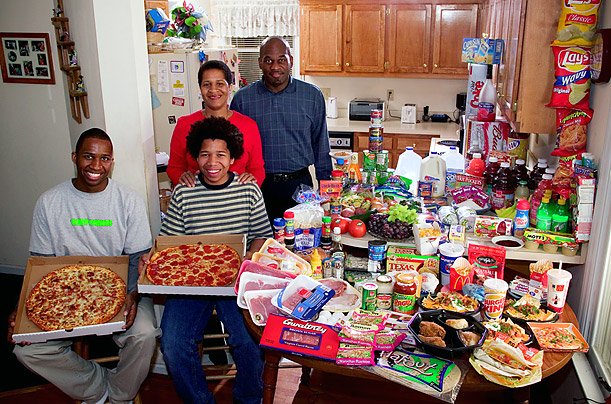
Amazingly, the United States also spends more on healthcare than any nation in the world. Despite spending $7,960 per capita, the United States has been ranked dead last when it comes to the quality of care. The fact of the matter is that when food intake is ignored — along with the subsequent toxic ingredients that go along with the processed food addiction — disease will arise. In the telling pictures below, taken from the book ‘Hungry Planet: What the World Eats’, you can see what the average family from each nation eats over the period of one week.


This family in the picture above is from North Carolina eats a diet almost entirely of processed and pre-prepared foods with heavy amounts of junk and fast food. Consuming mostly sugar-laden ‘fruit’ drinks and mega-sized sodas from Burger King and McDonald’s, this average American diet will ultimately lead to chronic disease and rampant sickness. Some favorite foods include pizza and fast food.
Mexico
Families in mexico also tend to consume sugary sodas and processed foods, though their fruit and vegetable intake is higher than the United States families observed. The family lists their favorite food items as pizza, pasta, and chicken.
Canada
Enjoying some of the same processed items as families from Mexico and the United States, Canadian families do consume processed chips and meats, though you will notice a more prominent display of vegetables and fresh fish on the table. An increased amount of yogurt and cheese is also featured.
Italy
Italian families enjoy their bread, pasta, and assorted fruit. With grains a major part of the diet, along with other carbohydrate-rich foods, Italian families tend to forfeit some meal options high in protein for ‘traditional’ Italian dishes like pasta with ragu. While many of these items are fresh or even baked at home, Italian families still consume large amounts of sodas like Pepsi. You can see that this family drinks about 6 larger-sized bottles per week.
China
This Chinese family prefers fried shredded pork with sweet and sour sauce, listed as their favorite dishes. Eating processed food items mixed with packaged meats and fish, this Chinese family eats more fruit than vegetables, and their produce selection is one of the smallest besides the United States.
Chad
This family resides in the developing nation of Chad and spends only the equivalent of $1.23 per week on food to feed the entire family. Their favorite food is soup with fresh sheep meat.
Japan
It may surprise you, but this Japanese family consumes a diet high in processed junk and sugary treats. They list their favorite food items as cake, potato chips, and sashimi.
Germany
This German family has adopted an American-styled nutritional regiment, stating that their favorite foods are pizza, vanilla pudding, fried potatoes, and fried noodles. You may also notice the largely increased amount of beer and other alcoholic drinks over the other nations.
Great Britain
Spending over $250 per week on food, the average family in Great Britain is eating mostly processed meals and candy. This family’s preferred foods include chocolate fudge cake, mayonnaise sandwiches, and prawn cocktail.
Tuesday, May 1, 2012
400 Calorie Fix
 400 Calorie Fix

Eat Anything, Anywhere!
Prevention's 400 Calorie Fix diet helps you lose weight effortlessly by fueling metabolism and revving energy so you stay satisfied. You'll eat four, 400-calorie meals each day. No food is off limits!
Top 400 Calorie Fix Tips
March 14, 2012
March 7, 2012
Mindy Hermann, RD March 6, 2012
Read more: Prevention.com
Wednesday, April 18, 2012
How To Eat Like a Naturally Thin Person

From: EatWithoutGuilt.com
The other weekend I was at a friend’s house for a party, when all of a sudden a woman came up to me and said “You’re having a piece of cake?”
“Yes,” I said, “and I’m enjoying every single bite.” The woman then replied, “Oh, you must be one of those naturally thin people…I can’t even look at a piece of cake and not put on 5 pounds!”
Little did this woman know that for at least half of my life I dealt with overeating, emotional eating, binge eating, and yo-yo dieting.
Quite often people see me eating a guilty food, see that I’m at a normal weight — so they just assume I’m a “naturally thin person.”
What people don’t realize is that now, I have a relaxed relationship with food. And that was the turning point for me. Changing my relationship with food. So much of what I learned about food, and my relationship to it, really came to light when I lived in France.
But it took time and it didn’t happen overnight. It was the small steps that I took that overtime became part of my lifestyle. It’s so much a part of my lifestyle now that I don’t even stop and think about it. I don’t think about doing or eating this, versus doing or eating that. It just comes naturally.
Here are just some guidelines that YOU can start implementing into your lifestyle:
1) Eat until satisfied, not stuffed. On a fullness scale of 1 to 10, I stop eating at around a 6 or 7. But I find many overeaters keep going until 8 or 10. Why? For some, they’re part of the “clean plate club.” As kids they might have been told about the starving children in the word, or look at not finishing their food as a waste. But it doesn’t have to be. Whatever I don’t finish I save for another time.
2) Use small portions. You know the phrase one’s eyes are bigger than one’s stomach? I find that often happens when I’mreally hungry. So instead of serving what I think I’ll need, I serve myself a little less. If I’m still hungry after that, I’ll take a bit more. But I always wait a few minutes before that second serving. You just might find you don’t need that second serving.
3) Don’t fear hunger. All too often we look at hunger as a condition that needs to be cured, meaning we’re so afraid of being hungry that we eat too often. It’s not the hunger that makes one overeat, often it’s the level of hunger. There’s a difference between a little growling in the stomach and being lightheaded because you haven’t eaten in 10 hours. It’s okay and it’s good to feel hunger. You should be hungry before you eat. Just like the level of fullness, you need to gauge your level of hunger. You want to feel a bit hungry before eating your meal, just not to the point that you’re ravenous, as that’s what often cases overeating.
4) Don’t use food to cure the blues. Sure, we all eat for emotional reasons from time to time, the difference is to recognize when you’re doing it and stop. I always tell my clients that awareness if the first step to changing a behavior. You have to be aware you’re eating for an emotional reason, and then take the steps to change it.
5) Eat more fruits and vegetables. Okay, I know you were secretly wishing this wasn’t true but it is. But I try get my servings of fruits and vegetables most days. And it’s easier than you think. Add fruit to yogurt, on top of cereal, in a smoothie, or even on top of some whole wheat pancakes. You can even have fruit as dessert. And don’t forget your veggies! I have at least one vegetable with lunch and dinner.
6) Get moving. And it doesn’t have to mean strenuous hours at the gym. I only exercise a few days a week for 30-45 minutes each. But I also do little things that add up. I take the stairs when possible and don’t spend 10 minutes looking for the parking spot nearest the entrance. I just park and then walk if need be. You’d be surprise how just moving your body a bit extra makes a big difference.
So follow these simple guidelines, slowly incorporate them into your lifestyle, and then one day you’ll overhear someone saying that you must be a naturally thin person!
Monday, March 19, 2012
Beginning Healthy Eating - Use your plate as a guide - replaces food pyramid
What people consider healthy eating is constantly changing, so it’s important to read recent research and stay up-to-date on what is happening. For example, the food guide pyramid that we learned in school so many years ago has changed numerous times. It currently looks like this:

Current Healthy Eating Guidelines are easy to find if you’re just willing to take the time. One suggestion that many experts give is to have a plan each week for what you’ll eat. Plan out at least dinners, if not all meals. This helps eating healhty because you can be prepared with all the ingredients you need instead of deciding what you want one night, realizing you don’t have what you need, and ordering pizza instead.
Another important aspect is to not deprive yourself from eating foods you like. When you do that it just creates a bigger crave and when you finally do eat that thing, you’ll binge on it, creating an even worse situation than if you just ate a little once in a while.
Snacks are a big part of why people aren’t healthy. It’s not a mealtime and they just want something small to hold them over until dinner. This video below will help you learn how to snack healthy!
Subscribe to:
Posts (Atom)