Friday, March 23, 2012

Monsanto ‘Biotechnology Book for Kids’ Caught Brainwashing Children


Anthony Gucciardi from Activist Post


Facing direct opposition from the public, biotechnology giants like Monsanto and Dow are now making a disturbing attempt to brainwash developing minds into accepting their genetically modified foods using blatant lies and propaganda.


In a last ditch effort to potentially sway public opinion, the Council for Biotechnology Information (CBI)  has launched the “Biotechnology Basics Activity Book” for kids.


With the intent to be used by ‘agriculture and science teachers’, the activity book spreads absurd lies about GMO crops — even going as far as to say that they ‘improve our health’ and ‘help the environment’.


The book can be seen on the organization’s website, and makes it extremely apparent that it is full of misinformation and propaganda that completely ignores scientific research surrounding genetically modified organisms (GMOs).


In fact, let’s examine some claims made by this book that serves as an ‘educational’ tool to be used by teachers.


Here is a short outline I created from the article at Activist Post:


Monsanto’s Propaganda that is spreading to our children through literature

From page # 1 of the Propaganda they are distributing.....
.........................They say that GMO crops............

1) Grow more food;


Not so much ……according to 900 scientists, GMO crops actually do not grow more food than traditional farming practices. In fact, they are simply not an effective tool to fight starvation in any capacity, thanks to their excessive costs and immense failure to yield crops.


Funded by the World Bank and United Nations, an organization was created known as the International Assessment of Agricultural Knowledge, Science and Technology for Development (IAASTD). Made up of 900 scientists and researchers, the group — whose mission was to examine the issue of world hunger — found that genetically modified crops were not a meaningful solution to the problem.


2) Help the environment
Do What?......Research has shown that Monsanto’s modified Bt pesticide is actually mutating the very genetic coding of insect life on the planet, creating super resistant ‘mutant’ bugs that are wreaking havoc on farms using Monsanto’s harmful concoctions across the globe. At least 8 populations of insects have developed some form of resistance, with 2 populations resistant to Bt sprays and at least 6 species resistant to Bt crops as a whole.


3) Grow more nutritious food that improves our health.
Do GMOs really ‘Improve Our Health’?. . . But what about the claim that GMOs improve our health? It turns out nothing could be further from the truth. A prominent review of 19 studies examining the safety of GMO crops found that consumption of GMO corn or soybeans can lead to significant organ disruptions in rats and mice – particularly in the liver and kidneys.


Of course the negative effects do not end there. Monsanto’s modified biopesticide, known as Bt, has been found to be killing human kidney cells in conjunction with Monsanto’s best-selling herbicide Roundup. That’s right, it exhibits direct toxicity to human cells. 

Consumers Ingesting Mystery Meat Treated with Poisonous Gas

From: Natural Society

As a method of passing off decayed meat as fresh, meat industries in many countries are treating meat with highly toxic gas. In fact, 70 percent of all beef and chicken within the United States and Canada are subject to the treatment of the poisonous gas known as carbon monoxide. Add this knowledge to the recently exposed ammonia-tainted ‘pink slime’ used in meat being served to millions of people and schoolchildren, and you may be reluctant to ever eat meat again. 
 

Carbon monoxide (CO) is a toxic colorless, odorless, and tasteless gas which essentially replaces oxygen in the blood. When individuals are exposed to higher levels of CO, it begins to cause detrimental effects after binding to a molecule in the blood that normally carries oxygen, known as hemoglobin. Lower levels of exposure results in headaches, confusion, fatigue, and nausea, while higher levels of exposure could result in unconsciousness, death, or long-term negative neurological effects.

In order for meat to stay fresh, it must be below a certain temperature before being consumed. Even a few degrees above the recommended temperature can result in bacterial growth and hastened spoilage. In addition, grocery retailers face a challenge in knowing the actual temperature of the meat since UV radiation from the display case penetrates the packaging. As a solution, the meat industry decided to use utilize carbon monoxide for atmospheric packaging to extend shelf life. It is also for this reason that meat exhibits a bright red color, even when it has spoiled.
meat before after carbon monoxide Consumers Ingesting Mystery Meat Treated with Poisonous Gas
Image provided by PreventDisease
“C. perfringens bacteria, the third-most-common cause of food-borne illness, has been proven to grow on what is considered fresh meat … about half of the fresh meat products [tested for these bacteria] are positive despite them being within the expiry period.  100% of … these cases come from packagers who adopted atmospheric packaging methods such as the use of carbon monoxide gas”.

Although meat itself has many beneficial properties, the processes in which most meat goes through is cause for alarm. Along with poisoning carbon monoxide being used to treat our meat, conventionally raised animals are injected with growth hormones, fed antibiotics, and given genetically modified grain – all of which are being passed along in the food chain to the consumers of these animals — humans. The use of antibiotics are creating drug-resistant superbugs, while growth hormones are causing various health problems due to hormone balance disruption. All the while, these animals are consuming life-threatening GM grain, which they would never naturally consume in the wild.
Being able to know of the many processes, treatments, and toxic ingredients added to meat and food as a whole is more important than ever. The labeling of genetically modified foods is an absolute must, as is the disclosure of the ingredients and processes food goes through before ending up in the hands of the consumer. However, until these changes come to pass, eating a well balanced organic variety of foods will cause avoidance of the numerous challenges which come with the consumption of conventional food.

Thursday, March 22, 2012

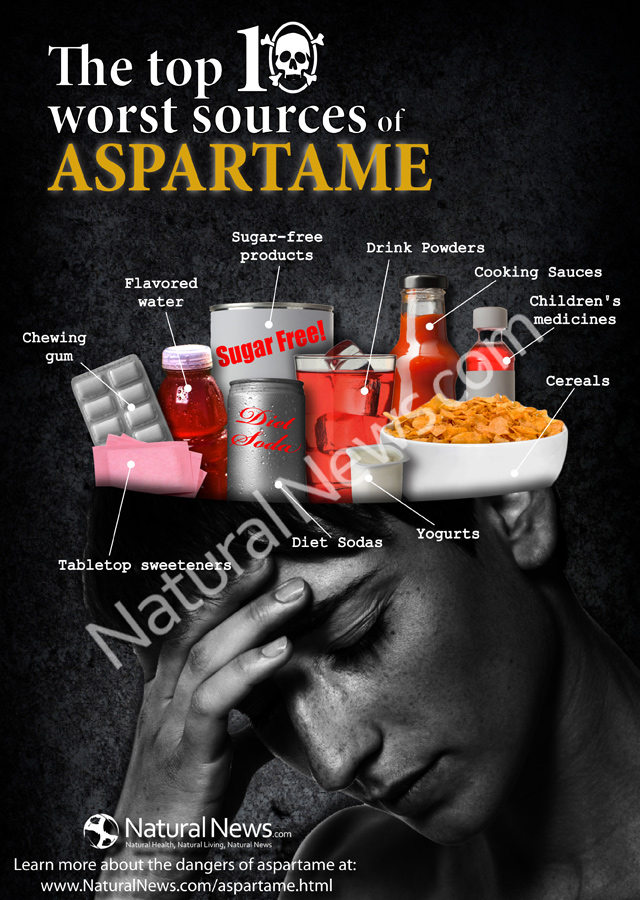
The Top 10 Worst Sources of Aspartame

From: NaturalNews Millions of Americans still have no idea that many of the beverages and foods they eat on a regular basis are contaminated with a neurotoxin posing as a sugar substitute. So to help raise awareness about the pervasive presence of toxic aspartame in the American food supply, Mike Adams, the Health Ranger, has released a helpful infographic that identifies the top ten worst sources of aspartame.

The infographic highlights the use of aspartame in chewing gums, tabletop sweeteners, flavored water products, sugar-free foods and beverages, diet sodas, drink flavoring products, cooking sauces, children's medicines, yogurts, and cereals. And while these are not the only sources of aspartame in the food supply, they are among the most common.


You can also learn more about the dangers of aspartame by watching this powerful interview between Mike Adams and Dr. Russel Blaylock, the foremost authority on aspartame and other excitotoxic additives:

"At every point in the fertility process aspartame destroys, beginning with the gleam in Mom and Pop's eyes: it ruins female sexual response and induces male sexual dysfunction," wrote Dr. James Bowen, a neurologist and chemist. "Beyond this, aspartame disrupts fetal development by aborting it or inducing defects. And if a live child is born aspartame may have heinously damaged the DNA of the baby, cursing future generations."

This is just one of the many side effects of consuming aspartame, of course, but it is one of the most serious. Millions of people think that using aspartame instead of sugar will help them safely lose weight, when in fact aspartame is far more harmful than even processed sugars like high-fructose corn syrup (HFCS).

"Both amino acids in aspartame freely enter the arcuate nucleus (at low dose), cause inappropriate release of hormones, and at high dose actually destroy these regulatory neurons," says Dr. Madelon Price, another aspartame expert. "This is why sexual dysfunction is associated with aspartame."

Contrary to the claims made by the U.S. Food and Drug Administration (FDA) and others that aspartame is safe, a wealth of independent research has verified that aspartame is linked to causing autism spectrum disorders, neurological problems, birth defects, and gastrointestinal problems, among other things.


Wednesday, March 21, 2012

A Perfectly Healthy Day. . . . . There's an App for That!


A Perfect Day Of Apps - Your trusty sidekick can boost your health. Here's how


You love your cell phone. So much that you’d even marry it—or at least forego some of life’s greatest pleasures for it. In fact, one-third of American adults would rather give up sex for a week than their phones, and 55 percent would rather give up caffeine, according to a survey by the mobile GPS company TeleNav. 
But don’t panic, there’s no need to choose. In fact, the plethora of apps available to you means loving your cell phone can be a big boost for your health. Check out these five easy-to-use apps that will get you through the day with a

Keeping Fit:  Endomondo     

Starting your day with some exercise is always a good call, and research shows that working out with a pal makes you more likely to keep at it. But what if your ideal gym buddy lives in LA and you’re in NYC? This fitness app lets you challenge friends far and wide and even send them pep talks in real time. Plus, it tracks your distance, speed, and calories. Think of it as a way to engage in some healthy competition with your bi-coastal bestie. (Available for iPhone and Android, free) 
An Exerciser's Best Friend An Exerciser's Best Friend
Eating Easy:  My FitnessPal       
You've heard it before: Calorie counting is a vital part of weight loss. But who wants to drag a notebook around all day to jot down each bite? MyFitnessPal takes the number crunching out of your healthy eating equation. Enter your weight loss goal, and then click on what you eat throughout the day (pick from 1,100,000 foods), and the app keeps a running tab. (Available for iPhone and Android, free)
Staying Perky:  Caffeine Tracker    
Can’t survive without that second (or fourth) cup of coffee in the afternoon? Caffeine Tracker will help make sure that you can enjoy a couple of energy bursts during your day without sacrificing sleep. Just enter in your caffeinated drink of choice—coffee, cola, or tea—and watch the graph to see when the energizing compound will exit your system. (Available for iPhone and Android, .99 cents)
Getting Busy:  My Days    
Whether you’re trying to have a baby, not have a baby, or simply monitor your periods, My Days app can help. The app asks you to put in your periods and, er, other fun activities to help map your ovulation and fertility. (Available for iPhone and Android, free)
Hitting The Hay:  Relax and Sleep     
Sometimes, a little bit of white noise can be all you need to catch some zzz’s. Now you can turn your phone into a white noise machine with the Relax and Sleep app. Choose from more than fifty ambient sounds, such as loons on the lake, the hum of an air conditioner, or the sound of a beating heart, and get ready to drift off to dreamland. (Available for Android, free)

Tuesday, March 20, 2012

What’s On Your Plate May Be Killing 50% of Your Healthy Cells


We’ve told you before about the dangers of genetically modified (GM) foods. But new research now suggests they may be even more dangerous than we thought.
The latest research shows that GM foods may actually be killing human kidney cells.
Watch Food Inc. HERE
The findings come from Dr. Gilles-Eric Séralini. He’s a top researcher at one of the oldest and most prestigious universities in France, the University of Caen.
“We were very surprised by our findings,” he says. “Until now, it (was) thought almost impossible for (these) proteins to be toxic to human cells. (Our) experiments show that the risks have been underestimated.”
You can read about his findings in the Journal of Applied Toxicology.
His findings come just days after another independent study also found that GM foods are dangerous to your health.
In fact, this other research shows they are toxic to human DNA…even in tiny amounts.
GM Foods…Triple Threat to Your Health
Monsanto is the biggest player in GM crops and farming. It produces an herbicide called Roundup. It also provides the tech behind 90 percent of genetically engineered seeds in the US.
Until now, it’s always been said that Roundup is safe for humans. They claim it’s only toxic to insects and is in no way risky to you.
But the new study shows this isn’t true.
Dr. Séralini and his team tested how the active ingredient really affects human cells. So he tested it out on human kidney cells. And he found that it kills them, even in very low dilutions.
When he tested the effect of it when diluted to 57.5 ppm, he found it kills up to 50 percent of healthy cells.
He further noted that this is “far below agricultural dilutions.”
But the bad news doesn’t end there.
He also tested GM crops. And he found that a protein in them also destroys human cells. It’s actually a toxin that’s produced in most GM crops like corn.
The final bit of research he came up with may be the most concerning.
He found that human cells were totally devastated when they were exposed to both Roundup and the protein. The combination of the two causes synergistic damage to human cells. In other words, when a GM crop (that already contains the protein) is sprayed with Roundup, the damage to your cells goes through the roof.
The news comes hot on the heels of another study which also shows bad results for GM crops.
Herbicides Devastate DNA
This study comes from the Medical University of Vienna. It was headed up by leading cancer researcher Dr. Siegfried Knasmueller.
This study was published in the Archives of Toxicology.
He wanted to see if Roundup poses risk to humans at any level. So he diluted it down and did his test on a solution that was 450-fold weaker than what’s normally used on crops.
And he still found that the herbicide shattered human DNA.
“We found toxic effects after short exposure,” he says. “Our findings indicate that inhalation causes DNA damage in exposed individuals.”
So if a concentration (that’s 450-fold weaker than what’s normally used) still damages your DNA, what does the full dose do to it?
What You Can Do
Because there’s so much evidence that shows GM crops are dangerous, you should make sure you’re cutting them out of your diet today.
As we’ve told you before, both soy and corn are two of the most genetically modified crops. So you should stay away from both of these food stuffs in the future.
The next thing you can do is check the label. More and more stores are offering lines that are labeled as non-GMO.
The third thing you need to think about is the meat that you eat.
That’s because this kind of damage doesn’t just come from GM crops like soy and corn. Any animal that’s raised on these crops will also pass the bad effects onto you.
So even if you’re avoiding corn and soy like we’ve told you to, you may still be in danger from the meat on your plate.
In other words, eating animals that are reared on GM crops can do your cells plenty of damage over time.
That’s a big reason why we often tell you to only buy meat that is grass-fed and fish that is wild-caught.
That label tells you that what you’re eating hasn’t been raised on GM crops.
So, you should get into the habit of looking at labels for this information. Also keep an eye on anything that says your food is organic, and pesticide-free.
Finally, when handling produce, be sure you wash it thoroughly.
Research suggests you need to soak fruit and vegetables for about 10 minutes in water.
After that you need to scrub the skin and rinse under the tap for at least one minute.
Wishing you good natural health,
Ian Robinson,
Editorial Director, NHD “Health Watch”

Monday, March 19, 2012

Beginning Healthy Eating - Use your plate as a guide - replaces food pyramid


What people consider healthy eating is constantly changing, so it’s important to read recent research and stay up-to-date on what is happening.  For example, the food guide pyramid that we learned in school so many years ago has changed numerous times.  It currently looks like this:
Current Healthy Eating Guidelines are easy to find if you’re just willing to take the time.  One suggestion that many experts give is to have a plan each week for what you’ll eat.  Plan out at least dinners, if not all meals.  This helps eating healhty because you can be prepared with all the ingredients you need instead of deciding what you want one night, realizing you don’t have what you need, and ordering pizza instead.
  Another important aspect is to not deprive yourself from eating foods you like.  When you do that it just creates a bigger crave and when you finally do eat that thing, you’ll binge on it, creating an even worse situation than if you just ate a little once in a while. 
Snacks are a big part of why people aren’t healthy.  It’s not a mealtime and they just want something small to hold them over until dinner.  This video below will help you learn how to snack healthy!

Friday, March 16, 2012

Break These 5 Bad Eating Habits Today!


Habits, good or bad, they are part of our daily behavior. 
And when it comes to eating, these habits can greatly increase the chance of becoming overweight. Below are 5 really bad eating habits that you can change today. Work on them every day until they’ve been replaced with healthier practices!

1. Bad Snacking
Snacks are great between meals to help you get to the next one. But don’t fall victim to buying foods labeled as “snacks” in your grocery store. Foods like crackers, cookies, chips, 100-calorie packs and granola bars won’t satisfy you. In fact, they’ll likely sabotage your nutrition plan, creating a negative effect on your blood sugar, cravings, body fat and energy.
 
Try this. Start each week by preparing snacks ahead of time. Fill several sandwich bags with nuts, raisins, seeds, cut vegetables or fruit.

2. Eating Somewhere Other Than the Table
Studies show families that dine around a table together on a regular basis eat healthier and are less likely to have overweight children.
 
Try This: Set a goal for a number of times you will eat around the table each week. Start small, just once if you need to, and build up your frequency. Over time, it should become a habit most nights of the week.
Focus on how and what you eat. Enjoy the meal fully, without distractions. No phones, computers or televisions allowed.

3. Eating Too Fast
The average person spends less than twenty minutes eating each meal. Eating fast poses a huge problem for your body’s natural hunger and satiety signals. It often leads to overeating.
 
Try This: Eat Slow. Allow yourself at least 30 minutes per meal. Every bite you take should be savored. Put down your fork between bites and chew at least 20-30 times. There is a time and a place where a meal or snack might need to be rushed, but that shouldn’t have to be at every meal.

4. Multitasking While Eating
Do you work through lunch? Fold laundry or pay your bills as you eat dinner? We are a multi-tasking society! We live in a nation of poor nutrition choices, which have played a huge part in our obesity problems. That alone justifies the need for eating to be a solely task in itself.
 
Try This: Take a break! Really practice not doing anything else while eating, unless it includes conversing or engaging with other people around you. Take the time to enjoy your meal. Fewer distractions will allow you to think clearly about your healthy food choices.

5. Poor Planning
You may have every intention of eating healthy, but you have to plan it. Our lifestyles set up a situation of easy-access, unhealthy food choices.
 
Try This: Healthy people meal plan. Plan your dinners a week ahead of time and stick to your plan. This naturally builds a healthy grocery list. Don’t forg